
Three takeaways from the Stryker Shoulder Arthroplasty Masters Meeting, Sydney 2026.
Two days as faculty at the Stryker Shoulder Arthroplasty Masters Meeting in Sydney (15–16 May 2026). Acromial stress fractures, perioperative nutrition, and the Mako robotic shoulder learning curve — the three threads I came home thinking about.
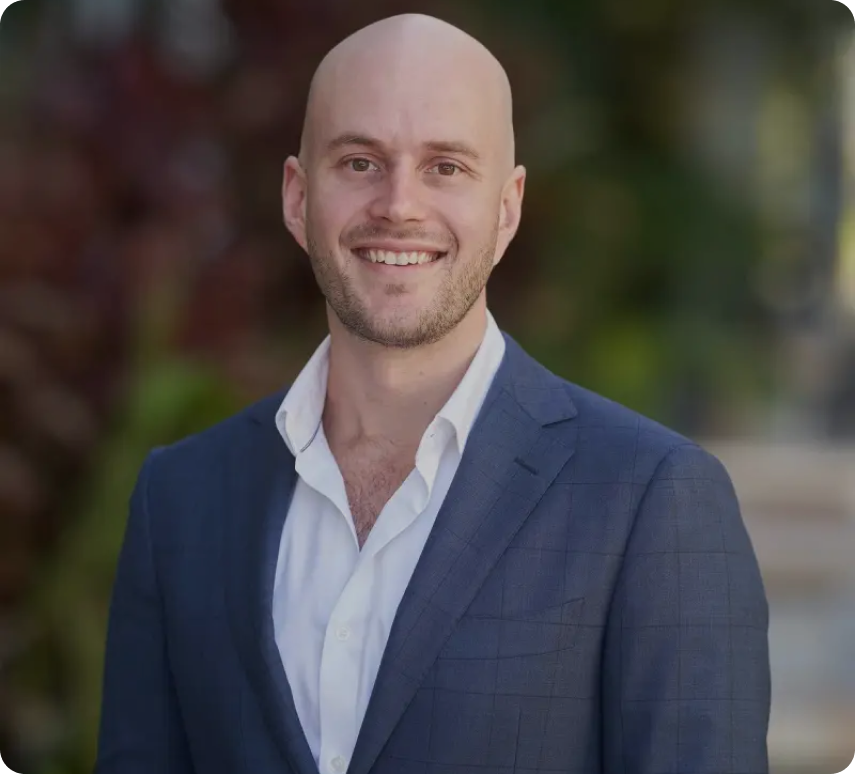
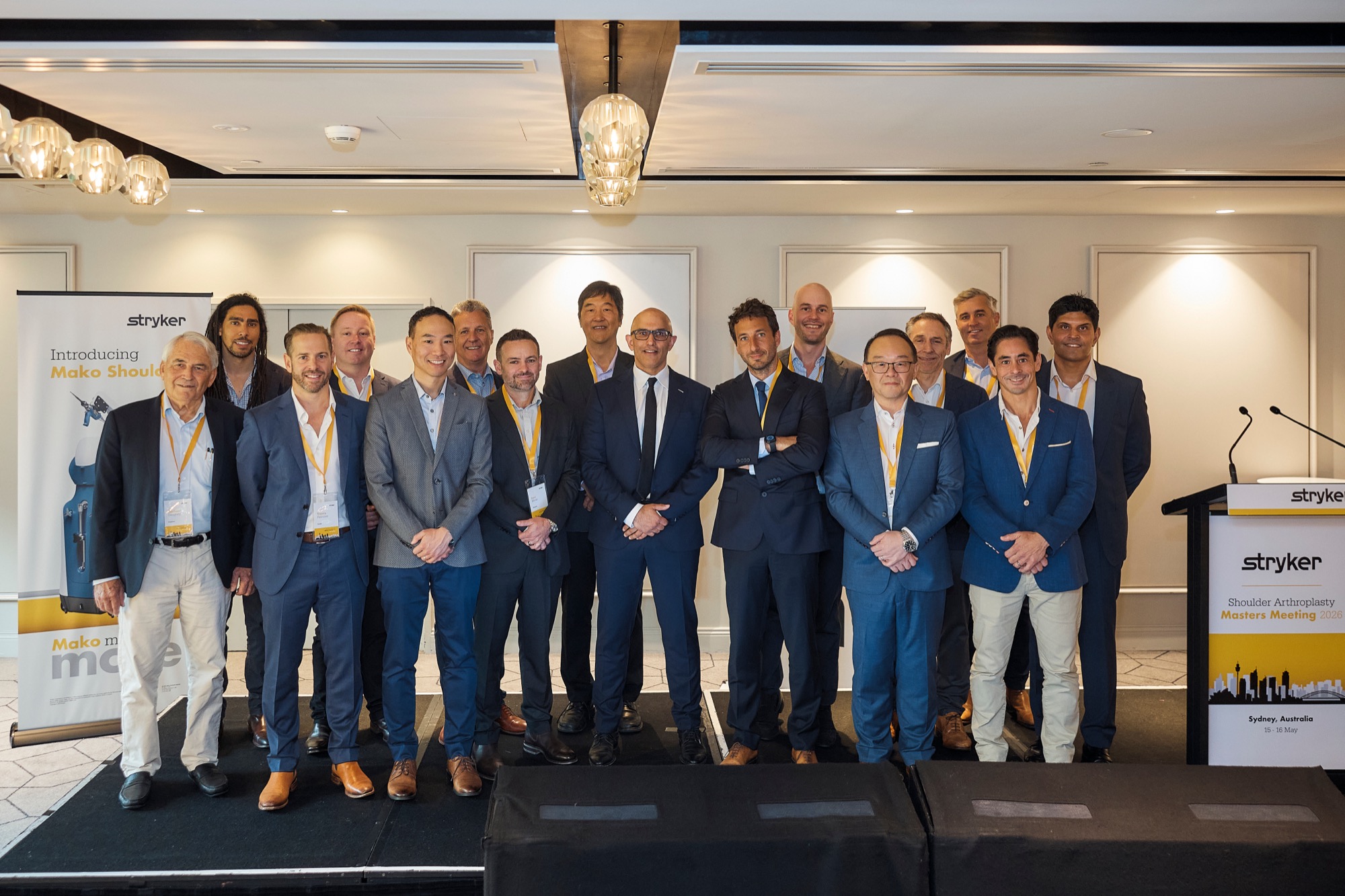
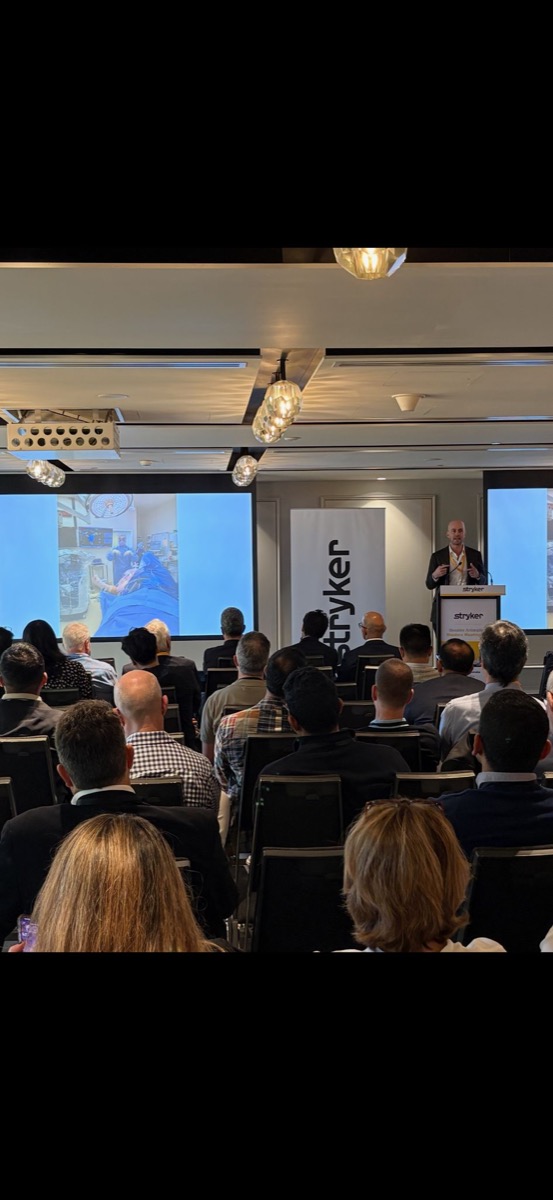
The Stryker Shoulder Arthroplasty Masters Meeting brought together an international faculty in Sydney across the weekend of 15–16 May. I was invited to present and to sit on faculty — a humbling invitation alongside an experienced group. Thanks to the convenors — Travis Falconer, Eugene Ek, George Athwal and Jean-David Werthel — for shaping two days that were genuinely useful rather than promotional. And to the rest of the faculty for the kind of unvarnished hallway conversation that you cannot get from a textbook.
I came home with three threads worth writing down.
1. Acromial stress fractures remain a hard problem.
One of the recurring difficulties in reverse total shoulder replacement is the acromial stress fracture — a fatigue fracture of the acromion (or the base of the scapular spine) that develops in the months after a reverse replacement, in a shoulder that has otherwise been doing well. The deltoid in a reverse construct is doing more work than it was designed to do, and the acromion is the lever it pulls against. Published rates sit at roughly 4–10% across series, more common in the cuff-tear-arthropathy population, in osteoporotic bone, and in shoulders that have had a previous open operation in that territory.1
What the faculty agreed on:
- Implant position matters, but it is not the whole answer. Greater glenosphere lateralisation increases deltoid tension and theoretically increases acromial strain. Excessive inferior tilt of the baseplate concentrates force at the base of the scapular spine. The Mako platform, with its haptic-guided burring and explicit pre-operative planning, is the right tool to dial these variables in — but a perfect plan does not eliminate the stress-fracture risk in a fragile acromion.
- Patient selection is the larger lever. The cuff-tear-arthropathy patient with established acromial thinning on pre-operative CT is a different risk than the patient with osteoarthritis and an intact deltoid attachment.
- Early recognition is the part most practices do poorly. The acromial stress fracture often presents subtly — a previously satisfied patient at 8–16 weeks post-op reports a new dull ache over the acromion, perhaps a small drop-off in active elevation. The standard radiograph misses many of these in the first weeks.
The bit I came home thinking about: ultrasound. Tibial stress fractures have a well-established ultrasound diagnostic pathway — periosteal oedema, cortical irregularity, hyperaemia on Doppler — that picks up the injury weeks before plain films do. There is no reason in principle the acromion should not lend itself to the same approach. The acromion is subcutaneous, accessible, and a sonographer with the right protocol can survey it in five minutes. I am going to investigate whether the practice can pilot a structured ultrasound surveillance protocol in the first 16 weeks after reverse replacement — particularly in the higher-risk group — and whether early recognition with protected weight-bearing changes the natural history. If it does, the protocol earns its place.
2. Nutrition is here to stay.
First time outside of rotator cuff repair that I have heard robust discussion about the role of perioperative nutrition. Different speakers, on different sessions, kept returning to the same point: the bone-implant interface in a reverse replacement, the soft-tissue envelope in a primary, the periprosthetic-fracture risk in the older patient — all of it sits on a metabolic substrate that the surgeon usually ignores until something goes wrong. Watch this space.
The case for taking this seriously is in part economic. Earlier this year our group at the University of the Sunshine Coast published a cost-of-illness analysis in the ANZ Journal of Surgery quantifying the burden of metabolic syndrome in elective surgery in Australia.2 The numbers make a straightforward argument: optimising the host biology before the operation is no longer a soft conversation. The four-to-six weeks before surgery are the most valuable window in the whole pathway.
I have written the deeper analysis up as a separate essay — the specific amino-acid science, the ESPEN protein targets, leucine and the mTOR pathway, HMB, immunonutrition, and the practical clinic changes I am making after this meeting. It also sits as the next step in the rotator cuff biology series alongside the ROHI essay and the biology of cuff repair long-form.
Read the amino-acid + nutrition essay
3. Mako robotic shoulder replacement — the Australian learning curve.
The third thread was the most personal. The Masters Meeting included an Australia-and-New-Zealand session on early Mako shoulder data — learning-curve effects, operative times, planning-versus-executed implant position, and the first comparative outcomes against conventional reverse total shoulder replacement in the early Australian series. The conversation was practical: how many cases until the operative time and the planning concordance stabilise, where the time is spent on the learning curve, and what the platform actually changes in a fragile glenoid.
Two things were striking. First, the learning curve in shoulder arthroplasty appears shorter than the published hip and knee curves — the haptic-guided burring on the glenoid is a more discrete task than the multi-cut robotic resections on the lower limb, and the planning concordance numbers come in faster than people expected. Second, the most useful application of the platform is exactly where the Denard line of argument predicted: the complex glenoid — B2 or B3 wear patterns, congenital dysplasia, post-traumatic deformity — where conventional instrumentation struggles to deliver the plan to the bone.
I am preparing the Sunshine Coast learning-curve data for presentation later this year. The early picture is consistent with the Australia-wide signal: faster than expected stabilisation of operative time, very strong planning-to-execution concordance on the glenoid baseplate, and a population that skews toward the harder anatomy that earned the platform its place. The Mako reverse total shoulder replacement procedure page covers the technique itself; the data will appear here when the case series is at a publishable depth. Update, August 2026: the first hundred cases and the learning-curve numbers are now published here.
Closing.
The faculty experience at a meeting like this is the part of the job that is easy to overlook. The cases get presented, the controversies get aired, the new tools get demonstrated — and then twenty minutes in the corridor at the end of the day with someone who has been doing this for fifteen years longer than you have reframes a problem you have been turning over for months. Thanks again to Travis Falconer, Eugene Ek, George Athwal and Jean-David Werthel for convening it; to the rest of the faculty for the honest conversation; and to Stryker, particularly Gavin Kargans, John O'Hare, Natalie Ings and Nami Hickson, for putting the meeting together. Apologies to anyone I have missed.
The three threads above are the ones I am acting on. The acromial-stress-fracture ultrasound idea needs a protocol. The nutrition pack needs to be built. The Mako data needs to be cleaned and written up. None of that is glamorous. All of it is exactly the kind of work that, over a career, separates a careful practice from a busy one.
Related reading on this site
- Perioperative nutrition and amino-acid augmentation in orthopaedic surgery — the deep-dive that pairs with takeaway #2 above
- Rotator Cuff Healing Index — predicting failure, augmenting biology
- The biology of rotator cuff repair: why technique has hit a ceiling
- Notes from Singapore and Sydney — the May 2026 faculty week
- How a CT scan becomes a shoulder replacement: inside Mako planning
- Mako robotic-assisted reverse total shoulder replacement (procedure detail)
- Research & Affiliations — the Coory et al 2026 cost-of-illness paper
References
- Mahendraraj KA, Carducci MP, Galvin JW, Golenbock SW, Grubhofer F, Jawa A. Predictors of acromial and scapular stress fracture after reverse shoulder arthroplasty: a study by the ASES Complications of RSA Multicenter Research Group. J Shoulder Elbow Surg. 2021;30(9):2113–2120.
- Norris P, Gow J, Arthur T, Rodda D, Coory J, Oprescu F, Neville S, Ralph N. The Economic Burden of Metabolic Syndrome in Elective Surgery: An Australian Cost-of-Illness Study. ANZ J Surg. 2026. doi:10.1111/ans.70588. PMID 41859958.