
Before we plan the operation,
what do you need your shoulder to do?
A guided patient system with five named phases, named contacts at every step, and written plans you can read at home. The shoulder you need back is the one that serves your life.
Hear it directly.
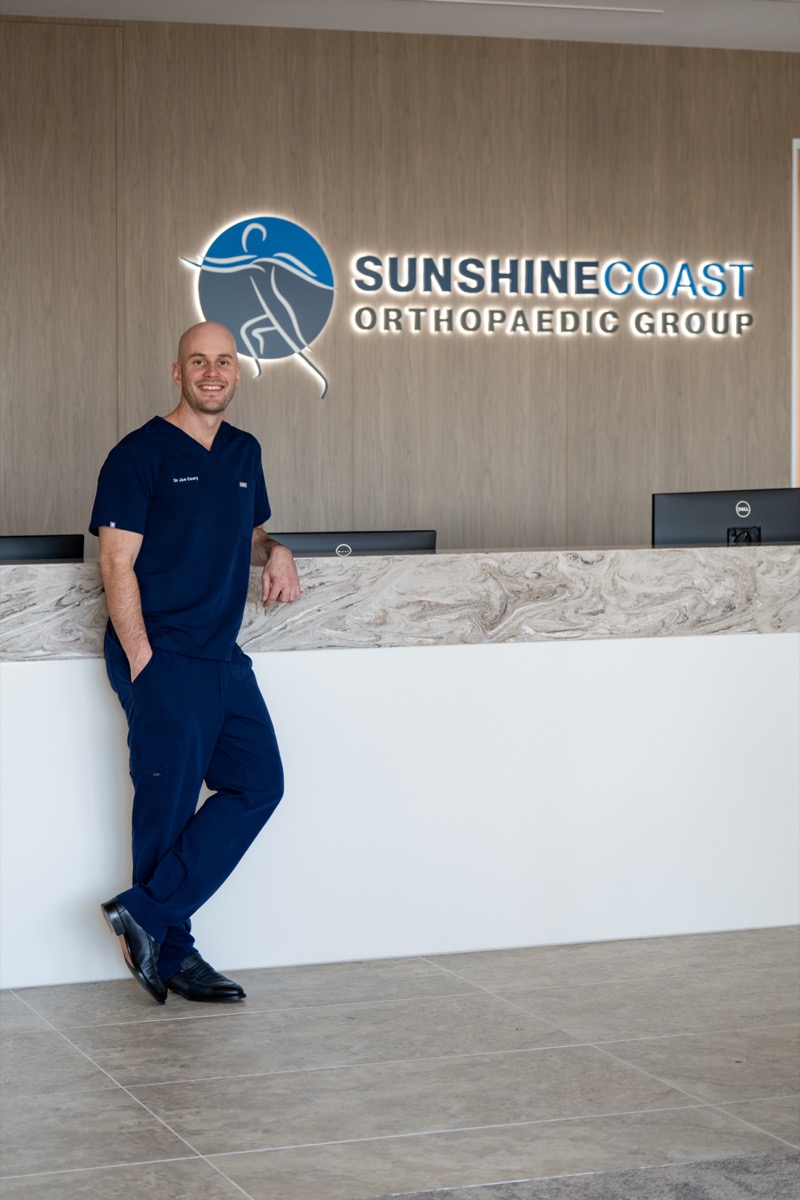
Dr Coory explains his approach to shoulder and upper limb conditions — and what to expect from the Guided Patient System.
Shoulder surgery is not a sub-interest. It is the practice.
A subspecialty shoulder practice on the Sunshine Coast, operating inside a guided patient system.
The shoulder is the most mobile joint in the body, and the one most likely to mislead both patient and surgeon when it goes wrong. Dr Joseph (Joe) Coory has built his practice around the careful management of shoulder problems - the rotator cuff that won't sleep at night, the recurrent dislocator in their early twenties, the arthritic shoulder that has finally lost its lift.
He performs the full contemporary range of shoulder surgery: arthroscopic (keyhole) cuff and labral repair, anatomic and reverse total shoulder replacement, and complex revision arthroplasty - with CT-based pre-operative planning across the spectrum, and Mako haptic-guided robotic burring for selected reverse cases. More on what to expect when you see a shoulder surgeon on the Sunshine Coast.
He also operates routinely on the elbow (cubital tunnel release for ulnar nerve compression) and on the wrist and hand (endoscopic carpal tunnel release, and open reduction internal fixation, or ORIF, of distal radius fractures).
The clinical work is held inside a coordinated patient pathway: five named phases, named contacts at each step, written plans before every milestone. You will know where you are.
Free patient self-assessment.
A validated 12-question self-assessment of how your shoulder is affecting daily life. Useful baseline before a consultation - and worth retaking after physiotherapy, injection or surgery to see if it has helped. Runs entirely in your browser; nothing is sent or stored.
Score bands
Significant daily limitation. Night pain usually present. Difficulty with basic tasks such as dressing, reaching, and carrying. A consultation with a shoulder specialist is strongly recommended.
Moderate impact on daily life. Overhead activities and sleeping are often affected. A clinical assessment would clarify options - physiotherapy, injection, or surgical review.
Mild-to-moderate symptoms. Some activities affected but most day-to-day function preserved. Physiotherapy and activity modification are usually the right first step.
Good shoulder function with minimal limitation. A useful benchmark to return to after treatment - retaking the score shows whether physiotherapy, injection or surgery has made a measurable difference.
Five named phases. Named contacts. Written plans.
Most patients leave their first orthopaedic consultation with more questions than they arrived with. The GPS was built to fix that. You will always know where you are.
Orientation
From the moment your referral arrives, your care coordinator has a named role. You will be contacted within one business day - not an automated response, a person who has read what you sent.
Preparation
Before you arrive in clinic, the imaging is in hand, the plan is sketched, and the appointment is built around what you need the shoulder to do. The first question is not about the MRI - it is about your life.
Intervention
If surgery is the right answer, Dr Coory performs it personally. The CT plan, the implant choice, the soft-tissue balance - the surgical plan that serves a surfer is not identical to the one that serves a plasterer, even when the anatomy looks the same.
Recovery
Rehabilitation is the operation that lasts. Your treating physiotherapist receives a procedure-specific written protocol on the day of surgery. Reviews are at protocol-defined milestones: 1 week, 6 weeks, 3 months, 6 months, 12 months.
Lifestyle Design
The measure of recovery is not the post-op X-ray. It is the Monday morning. What can you do now that you could not do before? That is the standard. Phase 5 is the philosophy that governs everything before it.
Mako robotic-assisted reverse shoulder replacement.
Dr Coory was the first surgeon on the Sunshine Coast to perform Mako robotic-assisted total shoulder replacement: CT-based, patient-specific planning paired with haptic-guided glenoid burring. The Mako shoulder application is currently approved for reverse total shoulder replacement only.
Guides patients come back to.
Practical answers to the questions you are actually asking — recovery timelines, cost breakdowns, surgical decision frameworks.
Rotator Cuff Surgery Recovery Timeline
From day one through twelve months — sling duration, physio milestones, return to driving, work and sport.
Read the timeline Choosing a surgeonHow to Choose a Shoulder Surgeon
What credentials to check, which questions to ask, and why subspecialty training matters more than advertising.
Read the guide Decision frameworkDo I Need Shoulder Surgery?
Which conditions are managed conservatively, when surgery becomes necessary, and what a specialist opinion involves.
Read the guideCommon questions
What patients ask first.
Who is Dr Joe Coory?
Dr Joe Coory (MBBS, Dip.Surg.Anat, FRACS, FAOrthA) is an Australian-trained orthopaedic surgeon on the Sunshine Coast, Queensland, specialising in shoulder and upper limb surgery. He is Director of Sunshine Coast Orthopaedic Group and a research partner of the University of the Sunshine Coast. He completed subspecialty training as a Bateman Orthopaedics Advanced Arthroplasty and Trauma Fellow.
What does Dr Joe Coory specialise in?
Dr Coory specialises in shoulder surgery (including Mako robotic-assisted total shoulder replacement, anatomic and reverse shoulder replacement, arthroscopic rotator cuff repair, and shoulder stabilisation), elbow surgery (cubital tunnel release, tennis elbow), and hand and wrist surgery (endoscopic carpal tunnel release, distal radius fracture fixation).
Where does Dr Joe Coory practise?
Dr Coory consults at Level 9, Maroochy Private Hospital, Maroochydore QLD 4558 and at Level 1, Noosa Civic Medihub, Noosaville QLD 4566. He operates at three hospitals: Buderim Private Hospital, Maroochy Private Hospital and Noosa Day Hospital. Phone: 07 5493 8038.
Does Dr Coory perform robotic shoulder replacement?
Yes. Dr Coory was the first surgeon on the Sunshine Coast and the second in Australia to perform Mako robotic-assisted total shoulder replacement. The Mako system uses CT-based 3D pre-operative planning with haptic-guided robotic burring for precise glenoid baseplate positioning. The robotic element is covered under standard MBS item numbers with no extra out-of-pocket charge for the technology. He performs it at Buderim Private Hospital and, since October 2026, on the Mako 4 system at Maroochy Private Hospital, where he performed the first Mako 4 shoulder replacement in Australia.
Do I need a referral to see Dr Coory?
Yes, a GP referral is recommended for Medicare rebates to apply. A GP referral is current for 12 months. A specialist-to-specialist referral is current for 3 months. Without a referral, the consultation is still possible but is not Medicare-rebated.
How long is recovery after shoulder surgery?
Recovery varies by procedure. Desk work is typically possible at 2-3 weeks. Manual work at 4-6 months depending on the operation and role. Return to driving is criteria-led. Reverse total shoulder replacement and robotic shoulder replacement use an accelerated sling protocol of one week. Anatomic shoulder replacement and rotator cuff repair require a sling for 4-6 weeks.
Does Dr Coory bulk-bill?
No. Dr Coory's practice operates on a private-fee model. A written fee estimate is provided before every consultation and before every operation. Medicare rebates apply with a valid GP referral. Workers' compensation (QLD WorkCover), CTP, and DVA patients are accepted with prior insurer approval.
What is the Mako robotic shoulder replacement?
The Mako robotic system is a CT-based 3D pre-operative planning and haptic-guided robotic arm that assists the surgeon during glenoid preparation for total shoulder replacement. It allows baseplate position to be aligned to a millimetre-level pre-operative plan. The Mako shoulder application is currently approved for reverse total shoulder replacement only.