
Teaching the Fellows Shoulder Essentials course: making complex shoulder surgery simpler to learn.
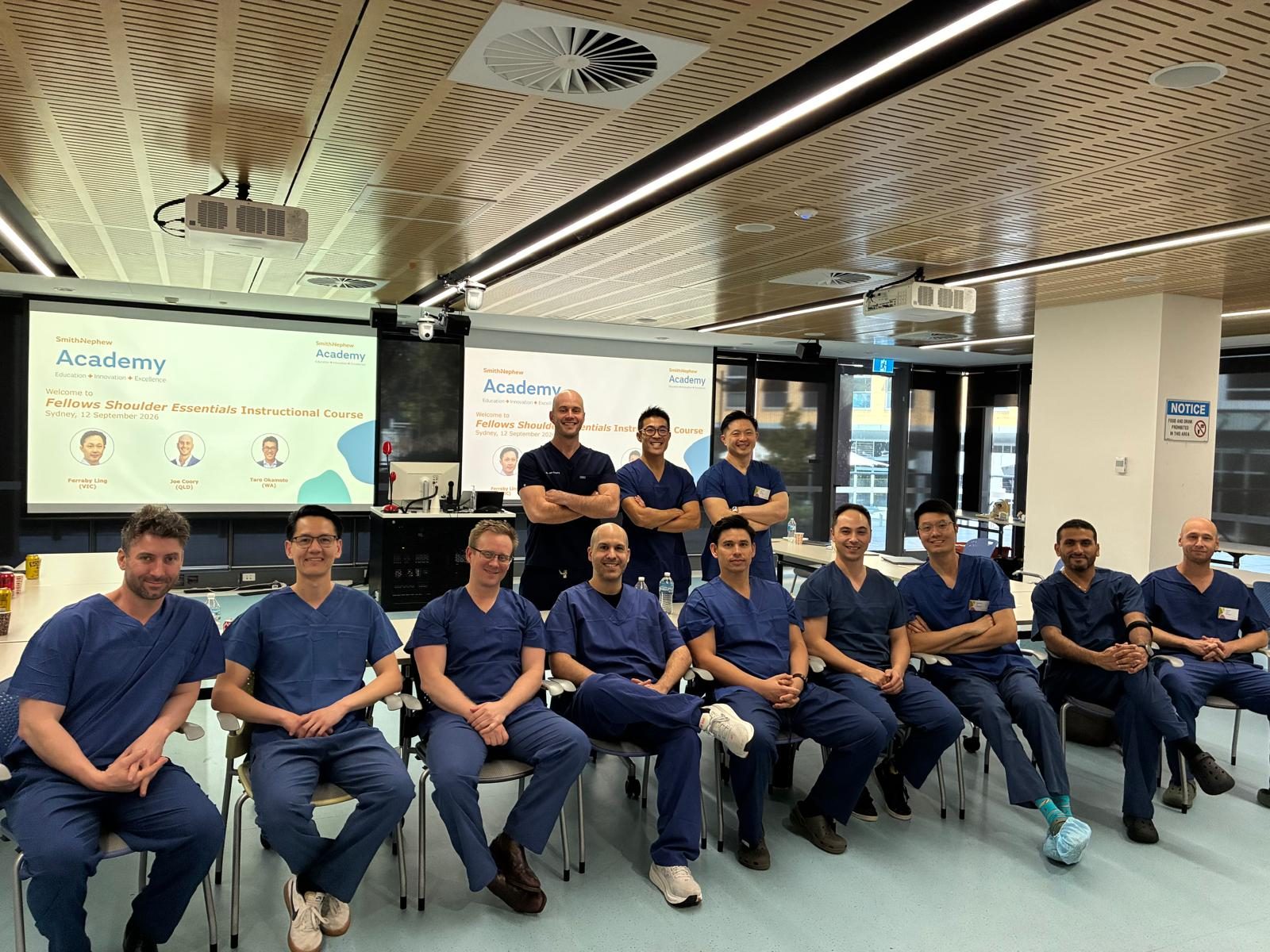
Dr Joe Coory was one of three faculty for the Smith+Nephew Fellows Shoulder Essentials Instructional Course (ANZ 2026), held at Macquarie University in Sydney on 12 September 2026. He taught arthroscopic shoulder stabilisation (Bankart repair and remplissage), rotator cuff repair and biological augmentation to ten fellows and early-career surgeons from Australia and New Zealand.
- Course
- Fellows Shoulder Essentials Instructional Course, ANZ 2026 (Smith+Nephew Medical Education)
- Where and when
- Macquarie University, Faculty of Medicine, Health and Human Sciences, Sydney, Saturday 12 September 2026
- Format
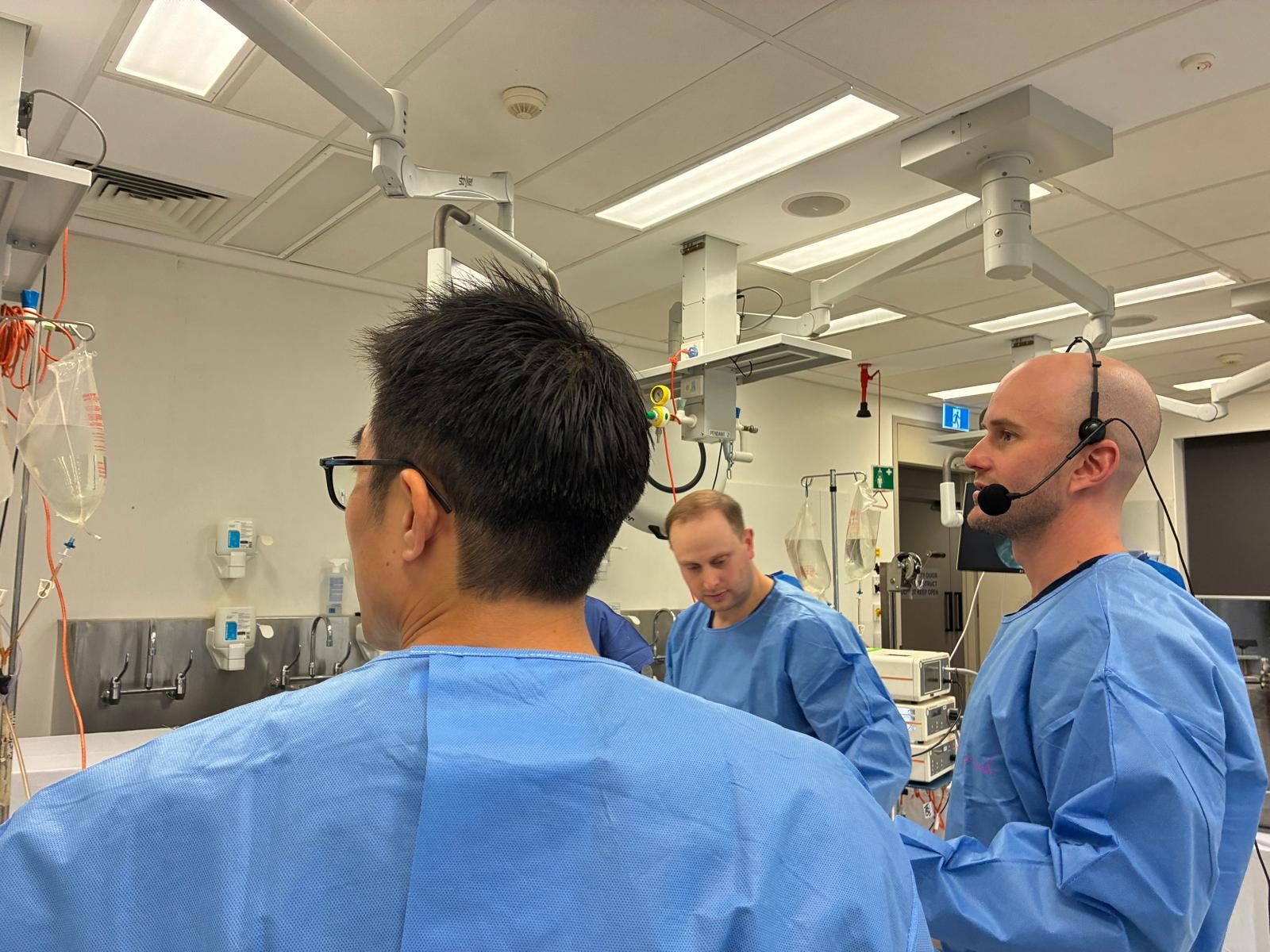
- Short technique talks, panel discussions, dry-model stations and two cadaveric wet labs
- Faculty
- Mr Ferraby Ling (Victoria), Dr Joe Coory (Queensland), Mr Taro Okamoto (Western Australia)
- Delegates
- Ten fellows and early-career surgeons from Australia and New Zealand
- Dr Coory's sessions
- Moderated the panel on arthroscopic Bankart repair and remplissage; presented "Biological Augmentation for Cuff Pathology: A Practical Perspective"; performed the live demonstration of a double-row rotator cuff repair with a bioinductive implant; instructed in both wet labs
What the day covered.
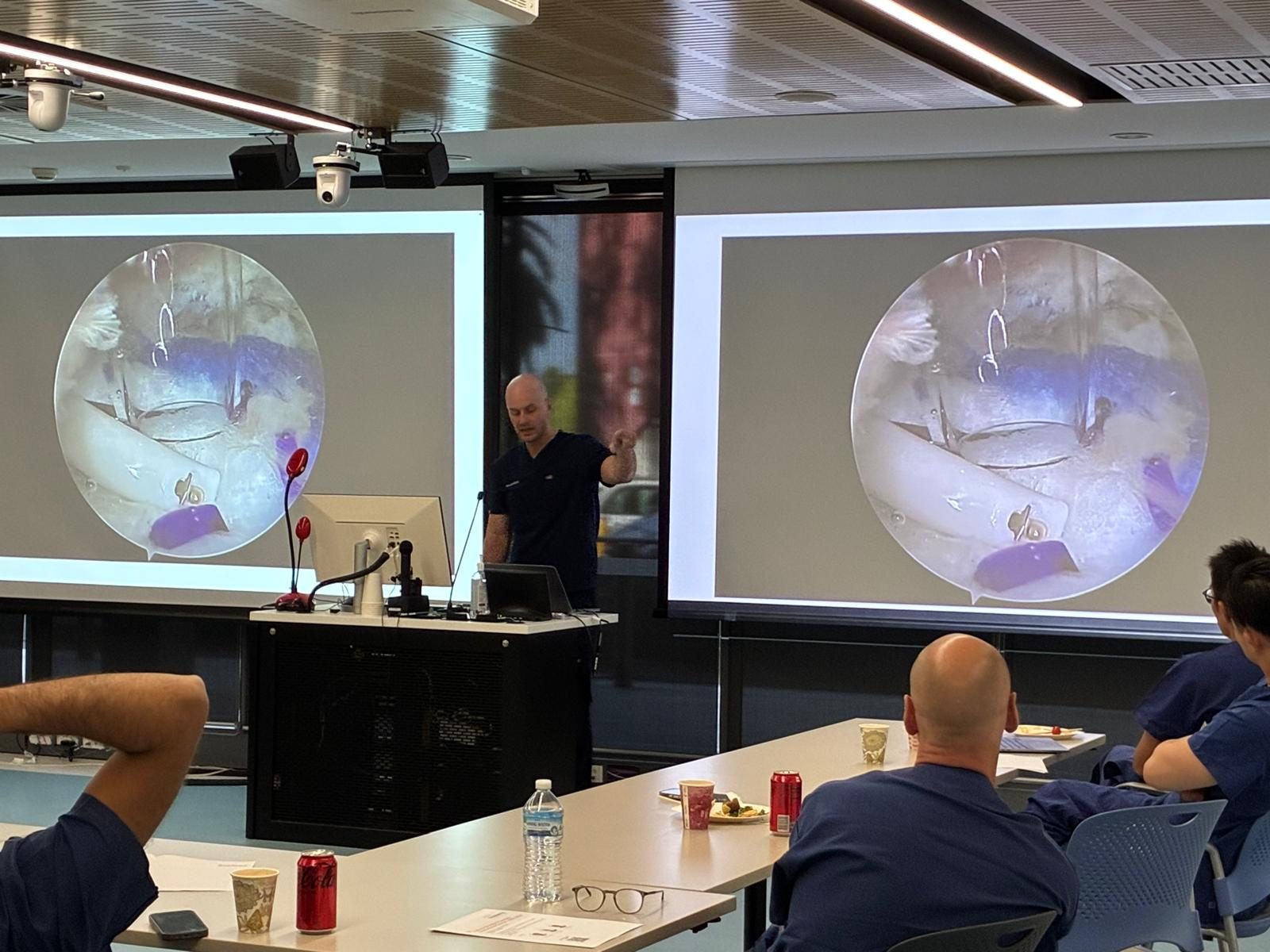
The course is built for shoulder fellows and surgeons in their first years of consultant practice. The morning was shoulder instability. I moderated the opening panel on arthroscopic Bankart repair and remplissage, Ferraby Ling led a step-by-step discussion of how to make the operation work (positioning, portal placement, anchor choice, suture passing, suture management and fluid management), and the delegates then moved through dry-model stations and into the first cadaveric lab.
The afternoon was the rotator cuff. Taro Okamoto led the session on repair technique. I spoke on biological augmentation for cuff pathology from a practical point of view, Ferraby covered the evidence in partial-thickness tears, and Taro gave the commentary on full-thickness tears. I then performed the live demonstration, a double-row repair augmented with a bioinductive implant, before the second lab.1
Why simple is the hard part.
At one station I watched a fellow set up for a remplissage. Good hands, well read, and working much harder than the operation requires. An extra portal. Three instruments where one would do. A suture passed, parked, retrieved and passed again. I recognised it because I used to operate like that.
The complexity in arthroscopic shoulder surgery is rarely in any single step. It is in the number of decisions a surgeon is carrying at once. An experienced surgeon is not doing harder things than a fellow. They are doing fewer things, in a fixed order, having decided most of it before the patient is asleep.
So the job of faculty is not to demonstrate the difficult version. It is to show how much can be taken away: the same portals every time, one way of managing sutures, a sequence you could recite. Once the routine is fixed, there is attention left over for the part that deserves it, which is the tissue in front of you.
One of the written takeaways afterwards was a single line about a step its author had assumed was difficult: "not so hard."
Remplissage, as the example.
Remplissage is a French word meaning "filling". When a shoulder dislocates, the back of the ball (the humeral head) is often left with a dent called a Hill-Sachs lesion. If the dent is large, or sits in the wrong place, it can catch on the front of the socket and lever the shoulder out again, even after the torn labrum at the front has been repaired. Remplissage fills the dent by fixing the tendon and capsule at the back of the shoulder into it, so that it can no longer catch. Added to a Bankart repair in the right shoulder, it typically lowers the risk of the shoulder dislocating again, at the cost of a small loss of external rotation in some patients.
It has a reputation for being fiddly. Taught as a fixed sequence, with the same portals and the same order every time, it becomes a short addition to the operation rather than a second operation. The longer discussion of when it is indicated is in Remplissage in shoulder instability and the age-at-first-dislocation rule.
Biological augmentation: what I told the fellows.
A rotator cuff repair has a mechanical half and a biological half. The surgeon controls the first. The second, whether the tendon heals to bone, is where repairs still fail, and it depends heavily on tissue quality and the patient's general health.
A bioinductive implant is a thin collagen patch laid over the tendon, intended to encourage new tendon-like tissue to form. The rationale is sound and the early studies are encouraging, particularly in partial-thickness tears and in tendons at higher risk of not healing. The evidence is still maturing, many of the studies are small, and most repairs do not need it.
My advice to the fellows was to learn to do it simply, so that the decision to use it is made on the tissue and the patient, not on whether it adds twenty minutes to the list. Nobody should mistake a tidy technique for a proven benefit. The biology of rotator cuff repair and the Rotator Cuff Healing Index set out how I make that decision.
Where simplifying stops helping.
Simplifying an operation does not simplify the decision to do it. A remplissage performed efficiently is still the wrong operation in the wrong shoulder. The fellows should hear that as clearly as they hear the technique, and so should patients: most shoulder problems I see are managed without surgery, and the choice of operation matters more than how neatly it is performed.
What teaching gives back.
Simplifying exposes the teacher. If I cannot explain a step in one sentence, I probably do not need it, and a lab full of fellows is an efficient way of finding the steps I have been carrying out of habit.
Thank you to Ferraby Ling and Taro Okamoto, to Ana Wilde and the Smith+Nephew medical education team for organising the day, and to the fellows, who asked better questions than I did at their stage.
Frequently asked questions.
What is the Fellows Shoulder Essentials Instructional Course?
It is a one-day course for shoulder surgery fellows and early-career surgeons in Australia and New Zealand, run by Smith+Nephew Medical Education. The 2026 course was held at Macquarie University in Sydney on 12 September 2026 and combined technique talks, panel discussions, dry-model stations and cadaveric training in shoulder instability and rotator cuff surgery.
Who taught the 2026 course?
The faculty were Mr Ferraby Ling (Victoria), Dr Joe Coory (Queensland) and Mr Taro Okamoto (Western Australia). Ten delegates from Australia and New Zealand attended.
What did Dr Joe Coory teach?
Dr Coory moderated the panel on arthroscopic Bankart repair and remplissage, presented on biological augmentation for rotator cuff pathology, performed the live demonstration of a double-row rotator cuff repair with a bioinductive implant, and instructed in both cadaveric labs.
What is remplissage?
Remplissage is a keyhole procedure added to a Bankart repair in some unstable shoulders. It fills a dent in the back of the humeral head, called a Hill-Sachs lesion, by fixing the nearby tendon and capsule into it, so the dent can no longer catch on the socket. In suitable patients it typically lowers the risk of the shoulder dislocating again.
What is biological augmentation of a rotator cuff repair?
Biological augmentation means adding something to a rotator cuff repair to support tendon healing, such as a bioinductive collagen implant laid over the tendon. Early studies are encouraging in selected tears, but the evidence is still maturing and most repairs do not need it. Whether it is appropriate depends on the tear, the tissue quality and the patient.
Does Dr Coory train other surgeons?
Yes. Dr Coory teaches at shoulder fellowship courses in Australia and internationally, mentors visiting orthopaedic fellows, and contributes to research with the University of the Sunshine Coast.
References.
- Smith+Nephew Medical Education. Fellows Shoulder Essentials Instructional Course, ANZ 2026. Course agenda, Macquarie University, Sydney, 12 September 2026. Education Unlimited
Related reading on this site
- Remplissage in shoulder instability: the missing middle between Bankart and Latarjet
- The biology of rotator cuff repair: why technique has hit a ceiling
- The Rotator Cuff Healing Index, and what we do when biology is against us
- Notes from Singapore and Sydney: biology, bone loss, and peptides
- Arthroscopic Bankart repair (procedure detail)
- Arthroscopic rotator cuff repair (procedure detail)