
One hundred robotic shoulder replacements, and what the learning curve actually showed.
The hundredth one is supposed to be boring. That is the point of counting them.
The first one took longer than I wanted it to.
In August 2025, at Buderim Private Hospital, I performed my first Mako robotic-assisted reverse total shoulder replacement.1 It took longer than I wanted it to. Not because of the robot. The robotic part of a robotic shoulder replacement turns out to be the fast learner in the room. It was everything around the robot that was new: the setup, the sequence, the small choreography of a team doing something together for the first time.
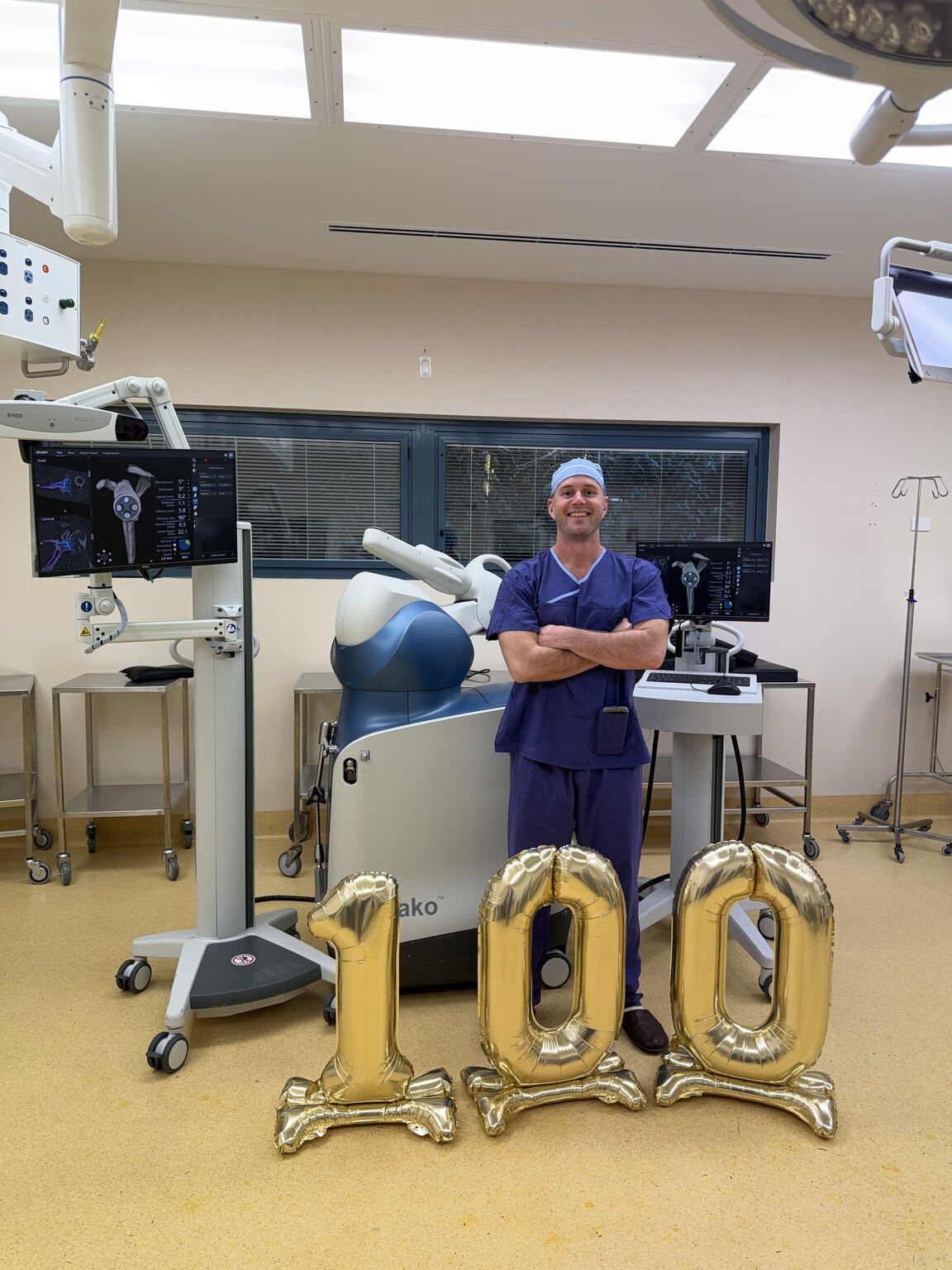
In August 2026, in the same theatre, with much the same team, I performed my hundredth.
I know what a round number invites a surgeon to say, so let me say something more useful instead. Because I counted every case along the way, I can tell you where the learning actually lived.
What the first fifty cases showed.
I have analysed my first fifty robotic cases and submitted the work for publication. It has not yet been peer reviewed, so read the numbers as one surgeon's prospectively counted series rather than as a general benchmark. The pattern was consistent:
- The technical robotic step settled quickly, within the first stretch of cases, at about eight minutes. The haptic-guided burring of the glenoid is a discrete, bounded task, and it stopped being the variable early.
- The operative-time learning curve was largely finished by around case 23.
- By around case 43, the robotic operation was taking no longer than my conventional one.
- The biggest remaining opportunity was never the robot at all. It was the human phase: the setup and the handovers around it.
That last point is the one worth sitting with. When a new platform is slow, the instinct is to blame the technology. In my series the technology was the part that stabilised first. What took longer to settle was a team learning a new sequence, which is a scheduling and a theatre-process problem, not an engineering one.
This is consistent with what the Australia and New Zealand faculty session on early Mako shoulder data was reporting when I wrote up the Stryker Shoulder Masters Meeting notes from Sydney: the shoulder learning curve appears shorter than the published hip and knee curves, and the planning concordance numbers arrive faster than people expected. I said then that the Sunshine Coast data would appear here once the series was at a publishable depth. This is that update.
What cases 51 to 100 taught.
Mostly this: the goal stops being improvement and becomes reproducibility.
The operation I plan should be the operation I perform, case after case. That agreement between plan and performance is the robot's real contribution, and it is a contribution I could not have documented previously. Conventional instrumentation can deliver an excellent shoulder replacement. What it cannot easily do is prove, case by case, that the implant position achieved was the implant position intended. Accurate glenoid baseplate position is the variable that most influences long-term survival in reverse shoulder arthroplasty, and glenoid-side complications remain a leading driver of revision in registry data.2 Being able to measure concordance, rather than assume it, changes what a surgeon can audit about their own work.
So the second fifty cases were not about getting faster. They were about getting the same result, repeatedly, including in the harder anatomy: significant retroversion, posterior bone loss, post-traumatic deformity, revision work where the conventional landmarks are unreliable. The full technique is on the Mako robotic shoulder replacement page, and the planning process is covered in how a CT scan becomes a shoulder replacement.
The robot decides nothing.
This needs saying plainly, because the marketing around surgical robotics rarely says it.
The robot has no opinion on whether you need a replacement at all, and most shoulders I see do not. It executes a plan a surgeon has made and must still stand behind. It does not perform the approach, the soft-tissue release, the humeral preparation, the trial and tension, or the closure. It does not choose the implant. It does not decide that surgery is the right answer. One hundred cases has not changed my view on that. It has hardened it.
If you have been told you need a shoulder replacement, the useful questions are still clinical ones: what does the imaging actually show, what has been tried, and what is the realistic gain for your specific shoulder. Do I need shoulder surgery? works through that decision, and most of the answers in clinic are still non-operative.
Why the hundredth should be unremarkable.
The first case was memorable. The hundredth was, I am pleased to report, almost entirely unremarkable. In surgery, that is the direction you want the story to run.
A milestone number is only worth publishing if it comes with the data behind it. The number itself does not make an operation better. What makes it better is knowing, and being able to show, where the learning sat, when it finished, and what stayed constant afterwards.
Update, October 2026: on 1 October 2026, at Maroochy Private Hospital, I performed the first shoulder replacement in Australia on Mako 4, the fourth generation of the system. It felt almost identical to the last one, and the learning from these hundred cases carried straight across. Read the note on the first Mako 4 shoulder replacement.
Frequently asked questions.
How many robotic shoulder replacements has Dr Coory performed?
Dr Coory has performed 100 Mako robotic-assisted reverse total shoulder replacements as at August 2026. The first was performed in August 2025 at Buderim Private Hospital, and the platform is now in routine use for selected reverse arthroplasty cases across the hospitals where he operates. Every case has been prospectively counted and recorded, which is what allowed the learning-curve analysis described in this article.
What is the learning curve for robotic shoulder replacement?
In Dr Coory's analysis of his own first 50 robotic cases, which has been submitted for publication and is not yet peer reviewed, the robotic step itself settled quickly and took around eight minutes. The operative-time learning curve was largely complete by about case 23, and by about case 43 the robotic operation was taking no longer than his conventional one. The learning that remained sat in the human phase around the robot: theatre setup, sequence and handovers, not the technology.
Does robotic shoulder replacement take longer than conventional surgery?
Early in a surgeon's robotic experience it does. In Dr Coory's own series the additional time had resolved by roughly case 43, after which the robotic reverse total shoulder replacement took no longer than his conventional one. The robotic burring step is a discrete task that adds only a few minutes once the team sequence around it is established. These figures describe one surgeon's series and should not be read as a general benchmark.
Does the robot perform the shoulder replacement?
No. The robot executes a plan the surgeon has made, and the surgeon remains responsible for that plan and for the operation. The Mako platform constrains the surgical burr to the planned volume of glenoid bone so that the implant position achieved matches the position planned. It has no role in deciding whether a shoulder replacement is appropriate in the first place, and it does not perform the approach, the soft-tissue work or the closure.
Why does reproducibility matter more than the milestone?
Once the learning curve is complete, the useful question is no longer whether the operation is improving, but whether it is repeatable. The measure Dr Coory uses is concordance: whether the operation performed matches the operation planned, case after case. Robotic assistance makes that agreement documentable in a way conventional instrumentation does not, which is its most practical contribution once a surgeon is past the early cases.
Do I need a shoulder replacement if I have shoulder arthritis?
Most shoulders assessed in clinic do not need a replacement. Shoulder arthritis is common and is frequently managed without surgery, and many painful shoulders turn out to be rotator cuff or stiffness problems rather than joint-surface problems. Whether a replacement is appropriate depends on your symptoms, your imaging and your function, and that decision is made at consultation, not by any device.
References.
- Buderim Private Hospital. Among first in the world to provide robotic shoulder surgery. News release, 8 August 2025. Read the source →
- Australian Orthopaedic Association National Joint Replacement Registry. Shoulder Arthroplasty Annual Report. Adelaide: AOA; 2024. aoanjrr.sahmri.com
- Coory J, et al. Learning curve analysis of the first 50 robotic-assisted reverse total shoulder replacements. Manuscript submitted for publication, 2026. Not yet peer reviewed.